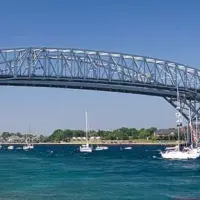
The Blue Water Bridge has officially claimed the title of the busiest commercial border crossing between the United States and Canada, surpassing the Ambassador Bridge for the first time in decades.
New data from the Bridge and Tunnel Operators Association indicates a significant shift in international trade routes, as commercial haulers increasingly bypass the Detroit-Windsor corridor in favor of the crossing in Port Huron and Sarnia.
The shift became clear in early 2025 and has continued through the first quarter of this year. Last year, the Blue Water Bridge recorded roughly 2.1 million commercial truck crossings, edging out the 1.9 million seen at the Ambassador Bridge. So far in 2026, the trend has continued with more than 531,000 trucks crossing in Port Huron through March, compared to roughly 496,000 in Detroit.
Numbers experts point to vast difference in toll costs as a primary factor for the change. At the Blue Water Bridge, commercial rates are currently $5.25 USD or $7.00 CAD per axle. In contrast, commercial tolls at the privately-owned Ambassador Bridge can reach as high as $20 U.S. or $28 Canadian per axle for some haulers.
The lower costs in Port Huron have effectively redirected continental supply chains north, allowing trucking companies to avoid both the higher fees and the urban congestion of the Detroit-Windsor area.
While the surge in traffic has highlighted the bridge’s growing role in trade, it has also increased pressure on local infrastructure. State and local officials continue to manage the resulting congestion on the I-94 and I-69 corridors.
The shift arrives as the region prepares for the opening of the Gordie Howe International Bridge, tentatively scheduled for later this spring. The new bridge has announced a starting commercial rate of $8.75 USD, $12 CAD per axle in an effort to remain competitive with the Blue Water Bridge while offering a lower-priced alternative to the Ambassador.